Sunday, 6 January 2013

Handmade books


I've been looking forward to a book-making session for a while as a way of recycling the huge mountain of printed papers in my garage. I started by sorting and sizing different papers

a) wall papers and other printed papers
b) drawn on papers
c) lined papers
d) plain papers
e) coloured papers
f) tissue papers

etc

and then collated singular piles for each person. Finally I made sure the book 'read' well, just like a good story (with a few surprises) and stitched/stuck it all together. In the time-honoured tradition of Christmas present making this took much longer than I planned

My favourite Christmas present - a great bundle of living willow for weaving on the allotment

Thankyou Stinky

Friday, 23 November 2012

Stevie Wonder

Just finished these prints inspired by late summer and dancing to Stevie Wonder...
I made them using lots of wax and digital print and then more wax
I loved sharing them with people and seeing them get into the vibe


Tuesday, 25 September 2012

Stencilling experiment

Just finished stencilling this wallpaper - my first stencils. Have always loved stencilled surfaces - more Japanese than Jocasta Innes. For this design I used a botanical watercolour by my grandmother as my inspiration. The process felt super simple and quick compared to cutting and printing with blocks...

I stencilled these papers as a way of trialling different looks. The client chose the simplest and plainest of the three. I'm now going to stencil straight onto her hallway walls - scary stuff...


Wednesday, 6 June 2012

Re-printing at the remakery


With so much patterned textile already out there, I'm becoming increasingly interested in ways of transforming old patterns into new, so in March I got together with the fab remakery in Brixton to have a go.

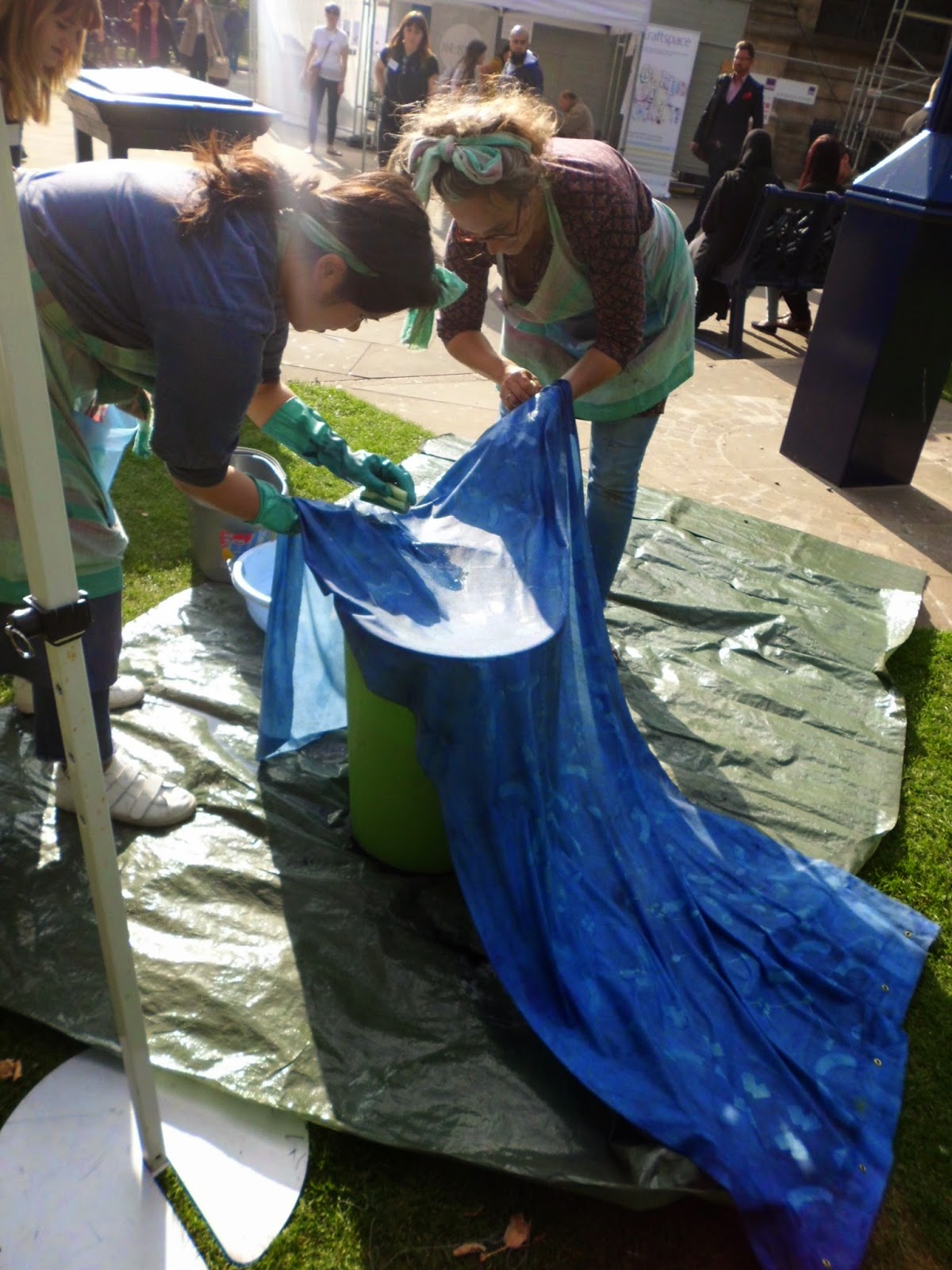
For our experimental print workshop, I sourced loads of pre-loved silk scarves and we up-cycled them using some natural dyes as well as neon, printing with some very basic materials (nothing more than a few cotton reels and one or two potatoes) into beautiful new bespoke creations.


In May, we got together again as part of Transition Town Brixton's Open Day to make our own 'Counting the Dots of Climate Change' dot - this time through stitching as well as print.

This was a global day of action co-ordinated by 350.org and lots of people joined us to make their own dot as a personal commitment to water conservation: every participant chose from a range of water-saving actions - from fixing a leaking tap (8.5 litres) to turning off their tap while brushing their teeth (18 litres) and then made their dot/dots in stitch or print or both!


the smallest dots = 1 litre
medium sized dot = 5 litres
largest dot = 10 litres

Together we  made a pledge to save 329 litres a day from now on....especially thanks to Lika from Norway via Kingston who helped sew the quilt together and was such great company on the day.

We sourced all  our materials through the amazing Scrap Store in Tooting- just pay one annual subscription fee and never buy new again. 

Prints for a Floating World

Here is some work from my 'Garden' project. I started with the Japanese idea of the 'Floating World' or Ukiyo-e, 'living only for the moment, turning our full attention to the pleasures of the moon, the cherry blossoms, the leaves...diverting ourselves in just floating...'

And went on to experiment with making a portable 'sky dish' or reflecting bowl that can help capture a sense of this floating world...creating simultaneously a sense of sensuality, containment, openings, vistas and temporality. These were some of the images I made this way


I went on to design a series of prints inspired by the incredible pools and puddles I was cycling through everyday (it was raining torrentially throughout this time); each puddle shape taking on a different character and spirit; as each print came to life I began to recognise particular people...

I discovered that love is a great aid to design and I really enjoyed surprising my friends with their prints once I had photoshopped them back into it. But  I used handblock printing to make most of the marks.

Through this project I have discoved a kind of 'digital hand', which enables me to combine my love of spontaneous handmade textures with fantastical shapes and sizes.

Thanks especially to Evie and Robin for all their help and inspiration.


Tuesday, 29 May 2012

Cloak of Invisibility


For our Transition fashion project I worked with the wonderful Jodie to make an invisibility cloak inspired by the incredible Dazzle camouflage battleships of WWI.

For this project, I loved printing BIG and tackled a huge sublimation print on the heat press - a bit of a nervy process...


I also fell in love with heat pressed plastics which have a beautiful luminous quality to them and can also be quite soft. I made a skirt with these, but would love to try making some softer more floaty pieces. Thanks to all those friends who gave me/collected plastic bags for me - I went through quite a melting frenzy!


Jodie modelled our pieces along with the beautiful wire veil that she wove. I may try wearing my cloak at Critical Mass, I embroidered on some great glass bead yarn to make me super visible/invisible on my bike.


Monday, 11 July 2011

Map of World Patterns - Coming to Australia


I have just about finished sewing my Map of the World - for now. There are still quite a few safety pins holding islands and continents together and many more stories to discover...

The last place I travelled to was Australia.


I made this huge and unknown (to me) continent from Aboriginal textile designs, designed for the local as well as tourist market (see http://www.tiwidesigns/) as well as blouse given to me by my friend, Hanna who emigrated to Australia in 2009.

I was really inspired by 1950's Textile designer John Rodriquez take on indigenous Aboriginal patterns: I copied the print from his wonderful 1950's boomerang skirt from and also sewed on some convict-type cloth, which I researched these by looking at the archive at the Sydney Powerhouse Museum.

Here's what Hanna has to say about going to live in a small rural community in Australia:
"Over the past few weeks...it slowly starts to feel more like home and a sense of day to day life is hitting in. I am getting to know people better, although with everyone knowing who we are it's still a bit of an overwhelming feeling when you walk through town or when I drop the kids off at school.

"It's a country community and the good side of this is the way they keep an eye out for each other and there is a good amount of trust still between people.

"And for me as "the doctors wife" - I'm regularly trying to free my mind from that sort of pressure I'm sensing, to be brave enough to surprise people and not fitting into anyone’s box. With almost an absence of diversity they anyway can't box us properly...

"And over time, when I've observed and learned more about this community I'm hoping to find ways to help change things for the better.

"It's quite a journey..."

You can see a piece of Hanna's blue chiffon blouse sewn into the map.

I’ve also sewn on some ‘Kandahar’ fabric in memory of the refugees, mostly from Afghanistan and Iraq, who were also coming to Australia and tried to land on Christmas Island in early 2010 but were drowned.

As for the indigenous population of Australia, I am fascinated to learn that local Aboriginal people, were able to use a dream painting as evidence to reclaim ancestral land: it's wonderful to see patterns on skin, paper, cloth and in dreams persisting with such powerful consequences.