Tuesday, 29 May 2012

Cloak of Invisibility


For our Transition fashion project I worked with the wonderful Jodie to make an invisibility cloak inspired by the incredible Dazzle camouflage battleships of WWI.

For this project, I loved printing BIG and tackled a huge sublimation print on the heat press - a bit of a nervy process...


I also fell in love with heat pressed plastics which have a beautiful luminous quality to them and can also be quite soft. I made a skirt with these, but would love to try making some softer more floaty pieces. Thanks to all those friends who gave me/collected plastic bags for me - I went through quite a melting frenzy!


Jodie modelled our pieces along with the beautiful wire veil that she wove. I may try wearing my cloak at Critical Mass, I embroidered on some great glass bead yarn to make me super visible/invisible on my bike.


Monday, 11 July 2011

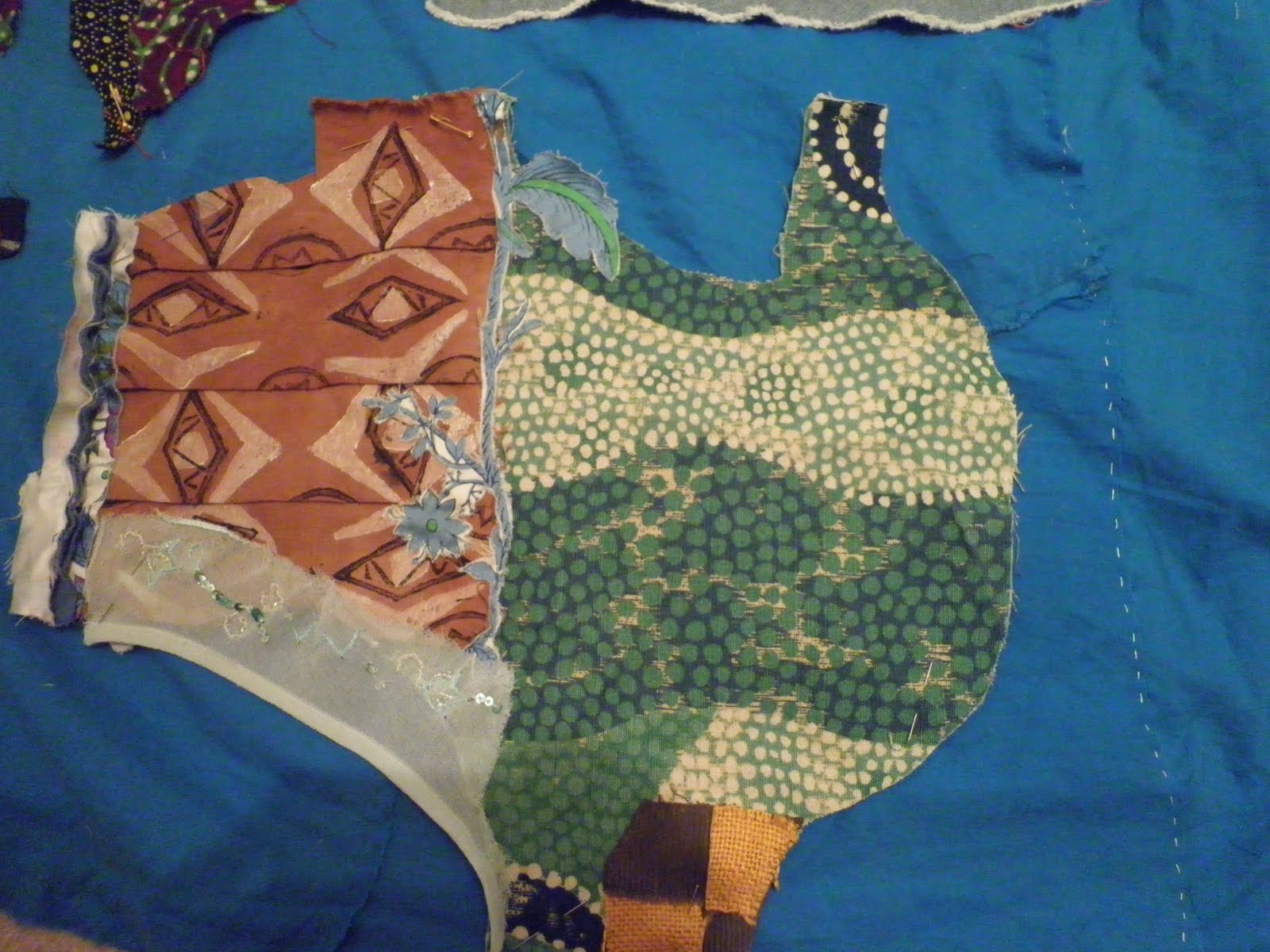
Map of World Patterns - Coming to Australia


I have just about finished sewing my Map of the World - for now. There are still quite a few safety pins holding islands and continents together and many more stories to discover...

The last place I travelled to was Australia.


I made this huge and unknown (to me) continent from Aboriginal textile designs, designed for the local as well as tourist market (see http://www.tiwidesigns/) as well as blouse given to me by my friend, Hanna who emigrated to Australia in 2009.

I was really inspired by 1950's Textile designer John Rodriquez take on indigenous Aboriginal patterns: I copied the print from his wonderful 1950's boomerang skirt from and also sewed on some convict-type cloth, which I researched these by looking at the archive at the Sydney Powerhouse Museum.

Here's what Hanna has to say about going to live in a small rural community in Australia:
"Over the past few weeks...it slowly starts to feel more like home and a sense of day to day life is hitting in. I am getting to know people better, although with everyone knowing who we are it's still a bit of an overwhelming feeling when you walk through town or when I drop the kids off at school.

"It's a country community and the good side of this is the way they keep an eye out for each other and there is a good amount of trust still between people.

"And for me as "the doctors wife" - I'm regularly trying to free my mind from that sort of pressure I'm sensing, to be brave enough to surprise people and not fitting into anyone’s box. With almost an absence of diversity they anyway can't box us properly...

"And over time, when I've observed and learned more about this community I'm hoping to find ways to help change things for the better.

"It's quite a journey..."

You can see a piece of Hanna's blue chiffon blouse sewn into the map.

I’ve also sewn on some ‘Kandahar’ fabric in memory of the refugees, mostly from Afghanistan and Iraq, who were also coming to Australia and tried to land on Christmas Island in early 2010 but were drowned.

As for the indigenous population of Australia, I am fascinated to learn that local Aboriginal people, were able to use a dream painting as evidence to reclaim ancestral land: it's wonderful to see patterns on skin, paper, cloth and in dreams persisting with such powerful consequences.

Saturday, 15 January 2011

'Kandahar, my homeland' and cutting up my curtains


I’ve just finished a short film about cutting up my curtains http://www.youtube.com/watch?v=Wwnp-Fzka_Y

My film was inspired by the Sanderson fabric, ‘Kandahar’ - with which our sitting room curtains are made and by the poems of Afghan refugee Shabibi Shah.


In the film, I imagine 'Kandahar' the pattern escaping into an idyllic English country garden…


'Kandahar' was originally adapted in 1967 from an Indienne block printed chinz pattern (c.1860) by the Sanderson design studio at their Perivale wallpaper factory. Sanderson then launched 'Kandahar' as a matching surface printed wallpaper and a screen printed cotton fabric as part of their 1968/9 Third Triad Collection. The fabric cost 12/5 (twelve and five pence) per yard. According to Sanderson's archivist Michael Parry, 'the design was named after the second largest city in Afghanistan because of its proximity to Pakistan & India (the Persian/Indian cashmere style having originated in the western Himalayas).'

Tuesday, 19 October 2010

Rebecca, Hugo and Tyler celebrate Chinese Moon Festival


This is my friend Rebecca (Ho Chi Wai) and her two beautiful sons Hugo and Tyler as they set off to celebrate the mid-Autumn festival or Moon festival. This is the traditional Chinese harvest festival and it is linked to the autumn equinox - the time when the moon is at it's fullest and roundest.
"We took paper lanterns to Norwood Park and floated them up into the night - but it was too windy and they blew into the only tree around. I was quite scared watching them burn there and the boys got scared too, so we came home."


"I love my boys in these clothes - they look so sweet, but I'm not such a traditional person. I've been raised more in a Western tradition and I married an English man."
"Personally, I feel that the price we have paid for Chinese culture is too high. In China, we have a saying - 'We're proud of our past, ashamed of our present and unsure about our future.'

Rebecca gave me a red silk purse to sew onto my map of patterns. It was given to her son, Tyler when he was born by his grandmother, Pak See. Inside was a tiny silver ankle bracelet with delicate silver bells on it.


Wednesday, 6 October 2010

The keffiyeh, Intifada and picking grapes in Piedmonte


This weekend, I met Sabrina and Michela. We were working together to harvest grapes, but spent more time eating, drinking and sharing stories. I got chatting to them because they were both wearing the keffiyeh, the traditional headress usually worn by Arab or Kurdish men. The distinctive woven checked pattern of the keffiyeh is very ancient and originally came from Mesopotamia, where it represented either fishing nets or grains of wheat.

Sabrina is wearing the classic black and white check kefffiyeh that became such a symbol of Palestinian resistance and national identity in the late 1980s, during the Intifada or 'shaking off'.
She told me: "Non sono revolutionaria ma simpatizzo," which probably sums up how a lot of people feel about wearing such a powerfully symbolic piece of clothing. Michela wears her scarf not for its 'radical chic' but for its colour, softness, warmth and the fact that it stops her from getting earache. She bought it two or three years ago from H&M children's clothing range.

Today, this symbol of Palestian identity is largely imported from China. The last producer of Palestian-made keffiyehs went out of business in 2006.


On my map, I've sewn a piece of keffiyeh (this one picked up in a New York street market) onto a piece of the Middle East. I'm still struggling with how to reconcile the immense power and significance of this cloth with the fact that it is so ubiquitous and almost meaningless in other ways. But maybe this is the fate of all great symbols.

Friday, 10 September 2010

Finland, munsala folkdrakt and Marimekko


Here is my beautiful friend Karin in the foldrakt of her village Munsala in Northern Finland.

Folkdraft means people's dress. The blue wool of Karin's skirt and waistcoat were handwoven by a neighbour in the village, Aira Mommo and the blouse and embroidery made by her mother Birgit.


Karin wore this costume to local dance competitions, where different villagers can be told apart by the colour of their weave or the embroidery on their shirt. These dances must be a wonderful sight - Karin says the costume is very hot to wear but makes you feel really special. People also wear their folkdraft to weddings and other special social occasions

On my map, I've embroidered some of Birgit's poppy flowers onto a piece of her open work and onto the deep blue Airo's cloth. The rest of Finland (and some of Denmark) is made from the famous and rather ubiquitous Marimekko pattern Unikko or poppy.


It was only as I was sewing that I realised how the flat colouring and bold outline of Maija Isola's design is so obviously inspired by the kind of folkdraft made by Birgit and Airo: they are not infact different patterns but part of one and the same design.

Many thanks to Mikki for giving me her Marimekko bag to cut up.


Thursday, 26 August 2010

Spain, Northern Africa and Owen Jones


The pattern I have made for Spain and Northern Africa is based on the designs of Owen Jones, the eminent Victorian designer, who spent nine years studying the architecture and design of the Alhambra Palace at Granada.

I have also included part of the same thing for a tiny piece of London on the map, which marks both where I live and where the Crystal Palace stood.

Jones was absolutely inspired by the Alhambra. He spoke about it as the 'summit of perfection' and promoted Moorish design and architecture through his seminal work The Grammar of Ornament, as well as by actually building a replica copy of the Alhambra Court at the Crystal Palace, which opened in Sydenham in 1854.

One contemporary visitor described visting the Crystal Palace and seeing 'the Alhambra Court, copied from the ruined Moorish palace of this name at Granada in Spain... [the sight] must strike every eye by the gorgeousness of the colouring, the elaborateness of the ornamentation, and the quaint grace of the architectural style.'


At the heart of the Alhambra Court was a copy of the celebrated Fountain of Lions, a magnificent alabaster basin surrounding by 12 lions in white marble. At Granada, the twelve lions had functioned as a clock with water flowing from a different lion each hour, but the Christians who conquered the city took the clock apart to see how it worked and never managed to put it back together again.


The Alhambra Court at the Crystal Palace was burnt down twice - most disastrously in 1936. This second destruction sealed its fate and it never rose from the ashes again. In 1937, some of Jones mosaics were sold as souvenirs at a garden fete in aid of St Philip's Church at Sydenham and, in 2006, some more were discovered at the back of the Park Ranger's Office.


As for the Moors of Granada, who had created 'this summit of perfection,' and a culture which was as thoroughly Arab and Muslim as Cairo or Damascus, they surrendered to the armies of a Ferdinand and Isabella in 1492. By the end of the 15th century, some 100,000 moriscos had died or been enslaved, 200,000 had emigrated, and 200,000 remained in Castile. Many of the Muslim elite, including Granada's former Emir Muhammad XII, found life under Christian rule intolerable and emigrated to Tlemcen in North Africa.